Fresh Herbal Kitchen Essential Oil Diffuser Blends
I've always liked the scent of fresh herbs, especially rosemary, so fresh herbal kitchen diffuser blends are something I had fun experimenting with. I like citrus essential oils too, but I don't necessarily want my kitchen smelling like lemon or orange all the time. Combining citrus with herbal essential oils gives me a little more variety, and I've found some combinations I really like.
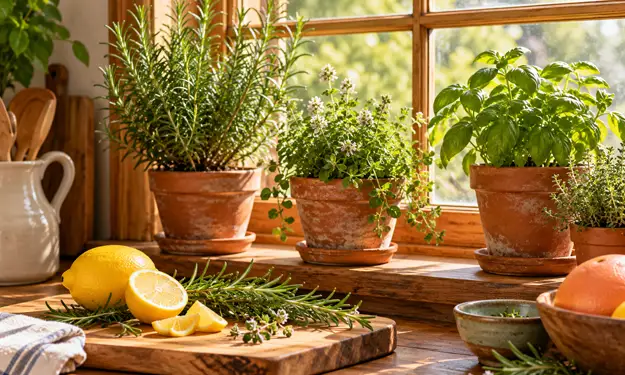
Just recently, I tried a diffuser blend using lemon, rosemary, and sweet marjoram, and it was really nice. The rosemary comes through nicely, the lemon gives it a fresh scent, and the sweet marjoram adds something a little softer without making it sweet or floral.
These blends are easy to put together, and you may already have most of the essential oils on hand. I've also included a few ways to adjust the drops depending on whether you prefer more citrus or a stronger herbal scent.
Using Herbal Essential Oils in the Kitchen?
Lemon and orange are popular choices for kitchen diffusers. They smell fresh and blend well with quite a few other essential oils. But adding herbs gives you more variety without having to use a lot of different oils.
Rosemary has a strong, fresh herbal scent, which is probably why I enjoy it so much. Sweet marjoram is a little softer, and cypress has a greener, slightly woody scent.
I especially like how these oils work with citrus. You still get that freshness from the lemon or grapefruit, but the herbs give the blend a different character.
And you really don't need five or six essential oils to make a good diffuser blend. Two or three can work just as well.
Fresh Kitchen Herbs Diffuser Blend
This combination of lemon, rosemary, and sweet marjoram has a nice fresh herbal scent without being too sharp or overpowering.
Fresh Kitchen Herbs Recipe
For a 200 mL diffuser:
- 3 drops lemon essential oil
- 2 drops rosemary essential oil
- 1 drop sweet marjoram essential oil
Adjusting the Fresh Kitchen Herbs Scent
You can also play around with the number of drops depending on whether you like more lemon, more rosemary, or a little extra sweet marjoram.
For a brighter lemon scent:
- 4 drops lemon essential oil
- 2 drops rosemary essential oil
- 1 drop sweet marjoram essential oil
For a little more rosemary:
- 3 drops lemon essential oil
- 3 drops rosemary essential oil
- 1 drop sweet marjoram essential oil
For a softer herbal scent:
- 4 drops lemon essential oil
- 2 drops rosemary essential oil
- 2 drops sweet marjoram essential oil
All three variations use the same essential oils, but the scent is slightly different depending on which essential oil you emphasize.
Rosemary, Grapefruit & Cypress Diffuser Blend
If you enjoy rosemary, like I do, but want something a little more outdoorsy, this is another combination you might like.
Grapefruit has a bright, slightly tart citrus scent that pairs nicely with rosemary. Cypress adds a fresh, woody green note without making the blend too heavy.
Rosemary, Grapefruit & Cypress Recipe
For a 200 mL diffuser:
- 3 drops rosemary essential oil
- 2 drops grapefruit essential oil
- 2 drops cypress essential oil
Again, I like rosemary, so here it’s front and center. The grapefruit adds a nice fresh citrus scent, and the cypress gives it a little more of that outdoorsy smell.
Compared with the Fresh Kitchen Herbs recipe, this one smells greener and a bit more like the outdoors.
If the rosemary seems too strong, try reducing it to 2 drops before increasing the grapefruit. You can also start with fewer drops overall if you prefer a lighter scent.
Using Rosemary Essential Oil
Rosemary is one of those essential oils that can smell different depending on what you combine it with.
Pair it with lemon, and you get a bright, fresh herbal scent. Add sweet marjoram, and the combination becomes a little softer. Cypress brings out rosemary's green, outdoorsy character, while grapefruit gives it a bright citrus note.
Rosemary essential oil is steam-distilled from the plant's leaves and flowering tops. Its scent is generally fresh, herbal, and somewhat camphoraceous, although different varieties can have noticeably different aromas.
You may see rosemary essential oil labeled as 1,8-cineole, camphor, or verbenone chemotype. These refer to differences in the oil's chemical composition, which can affect its scent.
Other Essential Oils That Pair with Rosemary
If you enjoy experimenting with essential oils, rosemary gives you a number of choices beyond the diffuser blends above.
- Lemon: Brightens rosemary's herbal scent and makes the combination smell fresher.
- Grapefruit: Adds a slightly tart citrus note without being overly sweet.
- Sweet orange: Softens rosemary and gives the blend a warmer citrus scent.
- Sweet marjoram: Adds a gentle, warm herbal note that balances rosemary's sharpness.
- Cypress: Brings out rosemary's green, woody, outdoorsy character.
- Bergamot: Adds a softer citrus scent with a subtle floral background.
- Lavender: Can soften rosemary's sharper edges, although I would use less lavender if I wanted the blend to remain primarily herbal.
I wouldn't necessarily combine all these oils into one diffuser blend. Choosing two or three that complement one another is usually enough.
Adjusting Recipes for Different Diffusers
The recipes above are intended for a 200 mL diffuser, but not everyone has the same size.
A 100 mL diffuser generally needs fewer drops than a 300 or 500 mL diffuser. Room size, ventilation, scent preference, and the particular essential oils you're using also make a difference.
Some oils, including rosemary, can be quite noticeable even in small amounts.
If you're using a larger diffuser, you don't necessarily need to multiply every essential oil by the exact difference in water capacity. Start with a modest amount, see how the blend smells, and adjust if needed.
You can also use my Diffuser Drop Calculator to estimate a starting amount based on your diffuser size, room size, and preferred scent strength.
The calculator also includes a recipe scaling tool, which is helpful when you want to maintain the proportions of a blend while adjusting the total number of drops.
Essential Oil Diffuser Tips
Essential oils may be natural, but they're still concentrated, so a little care is important.
- Follow the manufacturer's instructions and avoid exceeding its recommended oil amount.
- Diffuse intermittently rather than running your diffuser continuously.
- Keep essential oil bottles away from children and pets.
- If you have animals and they show any signs of discomfort, it’s recommended to stop use.
- If you have asthma, are prone to headaches, respiratory sensitivities, or another condition aggravated by airborne scents, avoid diffusion if it triggers symptoms.
Diffusing essential oils can make a kitchen smell pleasant, but it doesn't sanitize the air or replace ordinary cleaning. I also prefer to keep the diffuser away from food preparation areas.
Fresh Herbal Kitchen Diffuser Blends
I've really enjoy using rosemary in these fresh herbal kitchen diffuser blends. If you already have some of these essential oils, give the recipes a try and play around with the drops a little. You might find you like more rosemary, less citrus, or something entirely different. That's what I enjoy about making my own diffuser blends.