Surviving Love Bug Season
If you live in the South, then you already know - love bugs show up like uninvited guests that just won't leave. One day it's fine, and the next it feels like they've taken over your porch, greenhouse and shop, plastered themselves all over your vehicle and invaded every outdoor space you actually enjoy using when the humidity isn't so dang high.
We've lived with love bugs for several years now. Some years there aren't very many. Other years they're bad enough to be a nuisance.
And then there is this year.
We've been seeing love bugs since August, although initially there weren't that many. By September, that changed dramatically. I've never seen anything like what we're experiencing this year.
Our house is a light color, which honestly, I don’t think it helps. By evening there are thousands of dead love bugs around the house. We blow them away, and by the following day they've accumulated all over again.
They're on the house. They're in the greenhouse. They're around my plants. They're on the porch, and everytime we open the door to go in or out, they find their way inside the house.
At this point, I'm pretty sure they're everywhere except the one place I actually tried to attract them (more on that later).
This year's love bug invasion is what sent me looking more closely at these annoying little creatures - where they came from, why they suddenly appear in such enormous numbers and, what (if anything) I can do to make the spaces we actually use a little less appealing to them.
I'm realistic enough to know I'm not going to eliminate every love bug in the South.
But after this year? I'm highly motivated to make our little piece of it considerably less inviting.
What the Heck Are Love Bugs?
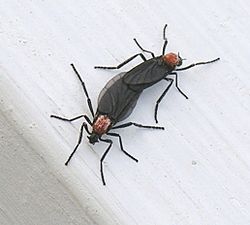
Love bugs (Plecia nearctica) are actually flies. They're mostly black with a distinctive reddish-orange thorax and are commonly seen throughout Louisiana and other Gulf Coast states.
And, of course, there's their most recognizable characteristic.
During love bug season, you'll frequently see two of them attached end-to-end. That's a mating pair and the reason they acquired the considerably more endearing name "love bug."
They're annoying, but they don't bite or sting.
Believe it or not, love bugs also serve a useful purpose. Their larvae feed on decaying vegetation and help break organic matter down and return nutrients to the soil.
So somewhere underneath my current annoyance, I suppose I should appreciate them – but, I'm still looking for that place.
Where Did Love Bugs Come From?
Considering how many are currently surrounding our house, I'd personally like to know who sent them.
And surprisingly, Florida can't take the blame for this one.
The love bug species we're familiar with, Plecia nearctica, occurs farther south through Mexico and Central America and expanded its range into the southeastern United States.
The species was formally described in 1940 from specimens collected around Galveston, Texas. At that time it was reported as being particularly common in Texas and Louisiana.
Apparently Louisiana was already in on this long before Florida became famous for them.
Love bugs eventually spread eastward around the Gulf Coast. They were first collected in Florida in 1949 and continued spreading throughout the state during the following decades.
Researchers have suggested that their expansion may have been helped along by prevailing winds, vehicle traffic, transported sod, expanding pasture habitat and the abundance of suitable habitat along highways.
Four Stages of the Love Bug
One of the more interesting things is that the flying love bugs driving us crazy are only the final stage of a much longer life cycle.
Love bugs have four distinct stages: egg, larva, pupa and adult.
Stage 1: The Eggs
After mating, female love bugs look for a suitable place to lay their eggs.
Rather than simply laying eggs "in the grass," females deposit their eggs around the soil surface near decaying vegetation and organic matter.
That can include leaf litter, grass clippings, compost and similar material. And they don't lay just a couple.
A female can lay hundreds of eggs.
Considering what we're experiencing this year, I'm beginning to think every female in the neighborhood was an overachiever.
Stage 2: The Larvae
After the eggs hatch, the larvae live around the soil surface and feed on moist, decomposing vegetation.
This is actually the beneficial part of the love bug's life.
They're essentially little compost workers, helping break down dead plant material and release nutrients back into the soil.
Moisture is important during this stage, and the larvae can spend months developing before they're ready for the next step.
I mulch practically everything because our Southern summers can be Hot! Mulch helps conserve moisture, moderate soil temperatures and protect plant roots when temperatures climb up into the 90s.
Organic mulch also decomposes and love bug larvae could potentially live underneath it.
Does that mean my mulch is responsible for the enormous number of love bugs around our house? I sure hope not because I ain’t takin’ all the mulch out of my gardens to let my plants bake in the Louisiana summer heat.
Love bug larvae can develop in grassy areas, roadsides, pastures, gardens and other places where suitable organic material accumulates.
Stage 3: The Pupa
Once the larvae have finished developing, they pupate in the same general environment where they've been feeding.
This is their transformation stage - somewhat like the chrysalis stage of a butterfly, although what eventually emerges isn't nearly as pretty.
The pupal stage lasts about 7 to 9 days.
Stage 4: The Adults
And they're back.
Adult love bugs emerge, feed, mate and start the entire cycle again.
What I found is interesting is that individual adult love bugs don't live very long. In Louisiana, they're generally around for a week or less.
So why have we been dealing with them since August?
Because the entire population doesn't emerge on one Tuesday morning.
A seasonal mating flight can continue for weeks as additional adults emerge. So the bugs I blew away yesterday aren't necessarily the ones covering everything today.
I'm basically removing yesterday's shift while today's crew clocks in.
Why Do They Suddenly Appear Everywhere?
Love bugs generally have major seasonal appearances in spring and again later in the year. In Louisiana, they can produce another mating flight in the fall.
We began seeing smaller numbers during August. By September, the population around our house exploded.
The unusually hot weather we're still having may contribute to how active the adults are during the day, but that doesn't mean September's heat created this enormous population.
These love bugs we’re seeing now, started their life cycle months ago. Moisture, temperature, available organic material and other conditions during the earlier stages of their development can influence populations.
So while I'd love to point at one particular weather condition and say, "That's why they're horrible this year," nature isn't always quite that cooperative.
What I can say is that this is by far the worst love bug season we've personally experienced since living here.
Why Do Love Bugs Like Vehicles?
If you've ever driven through a love bug swarm, you've probably wondered why they seem determined to throw themselves directly at your vehicle.
There's actually more going on than bad luck.
Love bugs have been shown to respond to some of the volatile compounds associated with automobile exhaust, as well as vehicle heat and vibration. Highways also provide plenty of open space for their mating flights.
And then there's all that mowed grass along highways and medians.
Grass clippings and accumulated thatch provide exactly the type of decaying vegetation love bug larvae can use.
So we've essentially created some pretty nice love bug neighborhoods alongside roads - complete with a steady supply of passing vehicles.
Do Love Bugs Prefer Light Colors?
Love bugs are commonly reported congregating on light-colored surfaces, and our house is light colored. They're terrible around it, but the shop, which is light colored as well, doesn’t seem to attract them as much as my back door – the one we go in and out of.
I have black netting covering some of the plants in my shade garden, including my hydrangeas. At times I've had hundreds of love bugs crawling all over that black netting.
My shade garden isn't unusually wet or mildewy, either. It's simply a normal garden that I mulch and water as needed.
So while light-colored and reflective surfaces may be particularly attractive to love bugs, that doesn't mean they'll only land on something light.
The Great Plunge Pool Mystery
Then there's my little plunge pool. I have a small round pool that I fill with water so I can soak after working outside in the yard.
The outside of it is black, while the inside and air-filled ring around the top are white.
Love bugs absolutely congregate on it.
Are they responding to the large white surface? Reflected sunlight? Heat? The contrast between black and white? Something else entirely?
I don't know.
But the plunge pool became particularly interesting when I compared it with another little experiment sitting nearby.
My Sweet Water Experiment to Attract Love Bugs Away from the House
Search online for homemade love bug remedies and you'll eventually find some version of a sweet-water trap.
One popular idea involves placing sweetened water into a container - often a white one - and sometimes adding dish soap or oil so insects that enter the liquid can't easily escape.
Since I currently have what appears to be an unlimited supply of love bugs, I decided to experiment.
I put out a red bucket containing water and soda.
With thousands of love bugs flying around, surely they'd be lining up for the free refreshments.
Nope.
So far, they've barely touched it.
Meanwhile, they're happily congregating all over my plunge pool.
That doesn't prove that sweet-water traps don't work. My bucket is red instead of white. Its location could matter. The size could matter? I don’t know?
That's why I wanted to experiment instead of simply repeating something I've read online and saying that it works.
Next I want to compare identical bait in different colored containers. Then I can compare plain water with sweetened water in otherwise identical containers.
My Peppermint Love Bug Spray
Long before I started conducting unofficial love bug experiments around the yard, I had one simple remedy I used during love bug season - peppermint essential oil.
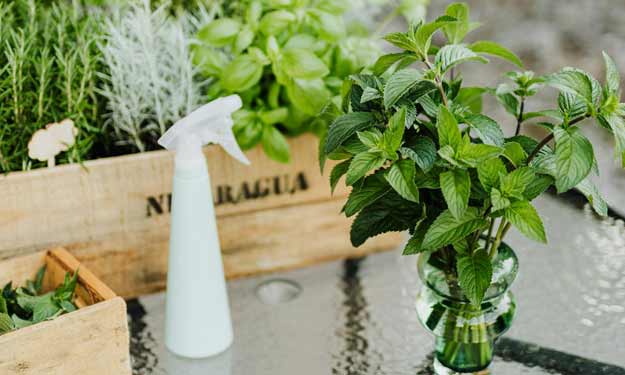
I make a vinegar, water and peppermint essential oil spray and use it around smaller areas where I don't particularly want love bugs congregating.
Does it eliminate them? No and from my own experience, though, freshly sprayed areas seem somewhat less appealing to them.
This is something I've personally observed, not a claim that peppermint essential oil has been scientifically proven to control love bugs.
DIY Peppermint Love Bug Spray
- 1 cup water
- 1 cup white vinegar
- 10 to 20 drops peppermint essential oil
Combine everything in a spray bottle and shake well before using.
I lightly spray areas such as door frames, window edges, porch railings and around my greenhouse entrance.
Essential oils don't remain outdoors indefinitely, so the effect doesn't last forever or for that long even but it appears to help. Heat, sunlight and rain all mean the spray will eventually need to be reapplied.
I don't spray it directly on my plants, and because vinegar and essential oils can affect some surfaces and finishes, always test an inconspicuous area first.
For me, this is very much an "it seems to help" remedy, not a miracle love bug cure.
Can a Fan Keep Love Bugs Away?
This is going to be one of my next experiments.
Love bugs aren't known for their impressive flying abilities, so I'm curious whether strong, continuous airflow can make a portion of our porch considerably less comfortable for them.
Our back porch is L-shaped, with part of the L leading toward a gate into the carport.
Our air conditioning went out and we have the large shop fan in the house, but once it’s available again, I'm going to experiment with positioning it somewhere on the porch to blow the love bugs away from the back door.
With the number of love bugs we have right now, it shouldn't take long to determine whether they're willing to fight a shop fan for their favorite spot.
Love Bugs Will Find a Way Inside
Keeping them away from outdoor spaces is one thing.
Keeping them out of the house has become another project entirely.
Almost every day I'm vacuuming dead love bugs from the floor inside our front door.
Our door sweep - that little "thingy" along the bottom - needs to be replaced. Even though I can't see an obvious opening underneath the closed door and I've temporarily blocked the bottom, I feel they're finding a tiny gap somewhere around the sweep or bottom corners?
And Then They Found the Motorhome
We discovered something similar with our motorhome.
When the house air conditioner went out during, we turned on the AC in the motorhome and opened the slide-outs for the kitchen, living room and bedroom areas.
At first, they were only getting in when we opened the door but shortly after sliding the slides out, they were all over the inside of the motorhome – everywhere!
We eventually brought the slides back in, and the problem improved considerably.
I can't say exactly where they were entering, but an extended RV slide creates long seams surrounded by seals and wipers.
During an ordinary love bug season, a tiny imperfection might never be noticeable.
When there are thousands of love bugs outside, apparently that's another story.
So inspecting door sweeps, weatherstripping, screens, greenhouse doors, shop openings and our motorhome slide seals has officially made my before-love-bug-season list.
I've learned something this year:
You don't have to see a gap for a love bug to find one.
Are Smashed Love Bugs Really Acidic?
Here's another love bug story that isn't entirely a myth - but isn't quite as dramatic as we've sometimes been led to believe.
You've probably heard that love bugs are extremely acidic and their splattered remains will immediately eat through the paint on your vehicle.
Freshly smashed love bugs aren't highly acidic. Research reported by the University of Florida found that macerated love bugs measured around pH 6.5 - fairly close to neutral.
Within about 24 hours, the decomposing remains measured around pH 4.25, becoming considerably more acidic.
That doesn't mean your vehicle's paint instantly dissolves every time you hit a love bug. In fact, the same UF information reports that paint coated with macerated love bugs in a humid indoor environment wasn't damaged even after 21 days.
The problem is more complicated. Leave bug remains plastered across the front of a vehicle while the Southern sun repeatedly heats and bakes everything onto the finish, you've created something I'd rather not leave sitting there.
So we wash them off when we get home.
Can You Kill Love Bug Larvae?
Can we just stop them before they become adults?
There has been research into possible biological controls, including naturally occurring organisms that can kill love bug larvae, but there isn't currently a practical love bug larval treatment recommended for homeowners.
LSU AgCenter doesn't recommend control for love bugs, in part because the adults are so mobile and suitable larval habitat is so abundant.
Blanket-treating my lawn and gardens with insecticides isn't something I'm interested in doing, either. I could kill beneficial insects and other organisms without knowing whether our property is even producing most of the love bugs we see.
Were Love Bugs Created in a Florida Lab?
You may also have heard, or read somewhere, that love bugs were created in a laboratory in Florida and accidentally escaped.
There's another version claiming researchers genetically engineered love bugs to control mosquitoes and then accidentally released them.
Neither happened.
Love bugs were already established along the Gulf Coast before they reached Florida.
University of Florida researchers studied love bugs after they were already established there.
And the mosquito-control story makes even less sense when you learn what love bugs eat. Adult love bugs feed primarily on nectar and pollen. They aren't mosquito predators.
So no secret experiment. No escaped genetically engineered superbug. No Florida scientist opening a laboratory door and saying, "Oops."
Nature managed this one all by herself.
Do Love Bugs Have Predators?
Another thing you'll sometimes hear is that love bugs have no natural predators, but they do.
Adult love bugs aren't especially appetizing to many predators, and LSU notes that their body fluids have repellent qualities.
Can You Really Keep Love Bugs Away?
If you're experiencing a major seasonal emergence, nothing I've tried – yet - is going to completely stop love bugs from showing up.
They're highly mobile, suitable larval habitat is everywhere and they can be coming from well beyond your own property.
For me, the goal has changed.
I'm not trying to eliminate every love bug.
I'm trying to make the places we use - the porch, greenhouse, shop and entrances to our house - less appealing and a little more comfortable during the worst part of love bug season.
That means keeping screens and seals in good condition, closing doors quickly, experimenting with airflow, cleaning up the dead insects, using my peppermint spray where I find it helpful and testing some of the homemade traps people recommend instead of assuming they work.
And I'm certainly not destroying a healthy garden just because love bug larvae like decomposing vegetation.
I'm not removing all my mulch and letting my hydrangeas bake in the summer heat.
The goal isn't to make our property inhospitable to every living creature.
I just wouldn't mind making it a little less hospitable to several thousand particular ones.
My Love Bug Experiments Continue
 I originally started writing this article because I wanted to share the peppermint essential oil spray I've used around our home.
Then this year's love bug season happened. Now it’s become an experiment.
I want to know what actually helps, what doesn't and whether there are things I can do before the next seasonal emergence that make a noticeable difference around our house.
I'm going to continue experimenting with container colors, homemade traps, airflow, peppermint spray and other reasonable ideas I come across.
References
LSU AgCenter - Plecia spp., Lovebugs (Diptera: Bibionidae)
University of Florida IFAS - Lovebug Plecia nearctica Hardy
University of Florida IFAS - Living with Lovebugs